
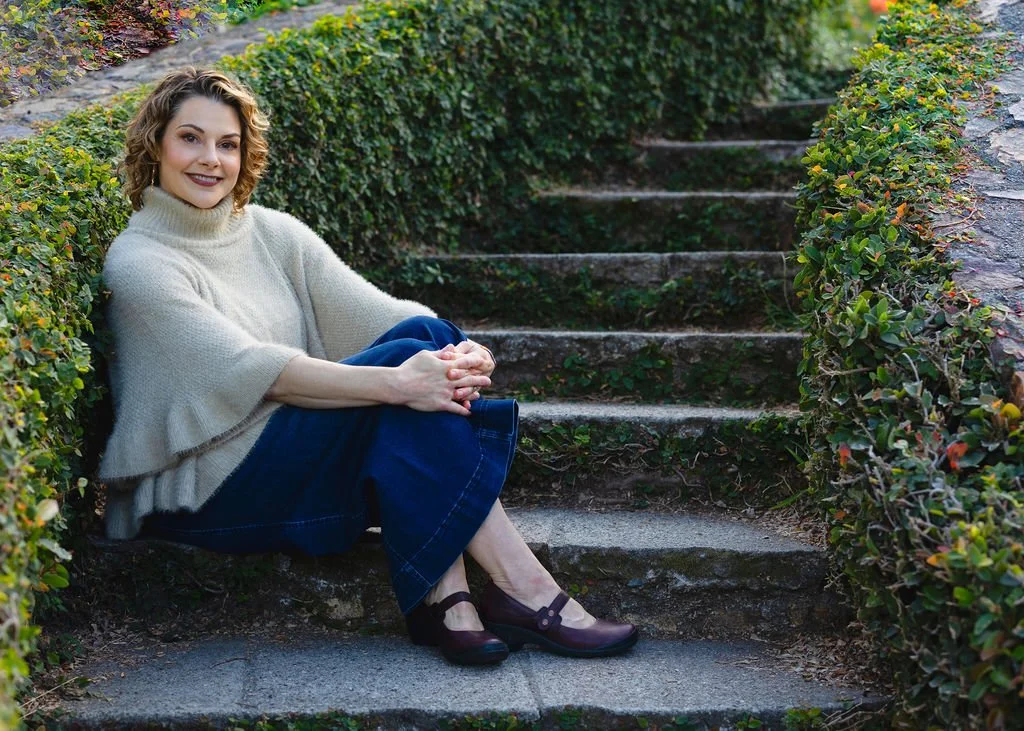
Who Am I When I No Longer Have to Brace? A Personal Reflection on Spine Surgery, Surrender, and Transformation
In ten days, surgeons will open my body from front and back and restructure my spine.
On the first day, they will approach through the front of my body to fuse L4 to S1. On the second, they will approach through my back and fuse T9 all the way down to the pelvis. A long, complex spinal fusion for scoliosis that has progressively worsened over time.
I feel profoundly fortunate to be in the care of a surgeon who specializes in cases like mine. That doesn’t make it less frightening.
I’ve lived with scoliosis since adolescence, though for most of my life it was considered relatively mild. It wasn’t until my forties that things began to change more dramatically. The pain increased slowly, then steadily. My posture shifted. Fatigue became more constant. Eventually I realized how much of my life had quietly reorganized itself around discomfort, compensation, and endurance.
Over the years I tried almost everything I could think of to avoid surgery: physical therapy, scoliosis-specific treatment programs, chiropractic work, private yoga lessons, injections, medications, lifestyle adaptations, and eventually a custom scoliosis brace made specifically for my body.
Exactly one year ago, I gave everything I had to trying to make that custom brace work. I wore it for 8–12 hours a day, every day. And honestly, it did help with pain. But living inside it was also pretty unbearable — like wearing a rigid corset wrapped around my torso. Hard to sit naturally, hard to move naturally, sometimes even hard to take a full deep breath.
What I realize now is that I wasn’t only trying to stabilize my spine. I was trying to hold myself together. Because wearing the brace forced me to confront what it would mean to continue living this way indefinitely: constantly compensating, constantly adapting, constantly bracing against gravity, pain, exhaustion, and fear.
I had to stop thinking about surgery as failure and begin thinking about it as surrender. Not surrender in the passive sense; not giving up. More like finally acknowledging reality. I could continue surviving, but I could not continue truly living this way.
I don’t usually write this personally on my professional website. Even when I write about grief, trauma, spirituality, or the unconscious, there is often still some protective distance between my life and the words themselves. But something about this experience keeps pressing through that distance. The closer surgery gets, the more emotionally porous I become; not only frightened, but exposed and tender. Raw in ways I didn’t entirely expect.
So I’m writing from inside it.
A great deal of how I’m understanding this experience has been shaped by years of training in depth psychotherapy, and by mentors and colleagues who are teaching me to think symbolically about suffering, transformation, the unconscious, and the body. That way of seeing does not make this easier. But it does help me feel that what is happening is larger than a medical procedure alone.
I realized I had stopped experiencing this as only a surgery. It began to feel more like a crossing — and because of the symbolic and mythological language I’ve lived alongside for years through depth psychology, I found myself thinking about old descent myths and stories of transformation, the human stories about what happens when a life can no longer continue in its previous form.
I am reminded especially about Inanna.
In the ancient Sumerian myth, Inanna descends into the underworld and must pass through seven gates. At each gate, something is stripped away: jewelry, garments, symbols of identity and power. By the time she reaches the underworld, she is completely exposed, just as I will be on the operating table.
Then comes the part of the myth that is most unsettling.
She is hung on a hook. Suspended between worlds. No longer who she was, but not yet who she will become.
That image keeps returning to me. Not because I imagine surgery as something noble or mythic, but because the image of her hanging there — suspended, exposed, undone — feels both psychologically and physically similar. Something in me is being stripped down: the competence, the self-sufficiency, the illusion that I can hold everything together alone. I am being brought face to face with dependency in a way that feels enormous. People will need to help me walk, help me shower, help me get dressed, help me get in and out of bed. As someone who has spent much of her life over-functioning and trying not to need too much from anyone, that reality feels seismic.
And yet I also know this experience is already softening something in me.
Leaving my practice has been one of the hardest parts. I love this work: sitting with people inside their grief, longing, transformation, and unraveling, accompanying them through uncertain territory. Stepping away from that, even temporarily, has brought its own grief. And strangely, its own initiation.
I have spent years accompanying others through crossings such as grief, illness, death, identity collapse, spiritual emergency, trauma and loss.
Now I am the one crossing.
In many old stories about transformation, there is some version of separation, descent, and return. First there is separation from ordinary life, as the structures that once organized identity begin dissolving. Then comes descent; the liminal territory where the old self no longer fully exists, but the new self has not yet arrived. Only afterward comes the possibility of return. Not restoration. Return, but changed.
I have already entered the territory of separation. My medical leave has begun. I am no longer, primarily, the therapist. I am the patient: the one being accompanied rather than accompanying. That inversion feels disorienting in ways I’m still trying to articulate.
And then there is the descent itself. The underworld. The in-between place where what was hidden beneath competence and forward motion can no longer remain hidden.
Knowing the map does not make the territory less frightening.
Part of me desperately wants certainty right now, control, reassurance. Another part understands that this experience is asking something else from me entirely — humility, surrender, trust, the willingness to be changed. Not because suffering automatically transforms people. It doesn’t. But because sometimes life brings us to places where the old ways of organizing ourselves can no longer continue, and we either harden against that reality or allow ourselves to be remade by it.
I do not know who I will be on the other side of this. I do not know what reorganizes when compensation is no longer structurally necessary. These are not rhetorical questions. They feel genuinely open to me.
Lately even ordinary things feel strangely vivid: playing with my dog, standing in the kitchen, rolling over in bed without acute pain, being able to put on my own shoes. Everything becomes more precious near a crossing.
And perhaps that is part of what initiation has always been about — not transcending the body, but returning to it. Returning to vulnerability, dependency, mortality, tenderness. Returning to the profoundly human reality that we cannot hold ourselves together forever.
The axis mundi — the ancient image of the world axis — was never static. The sacred tree grew. The pillar was sometimes torn down and rebuilt on the same ground, but changed. What made it sacred was not permanence. It was its function: to orient, to connect, to hold a world together.
I am about to have my own central column taken apart and reconstructed. The axis that held me, curved and compensating and mine, is being remade. I don’t know what it will hold when it’s finished. But I’m trying to trust that something can be built there. That the bones will fuse. That return is possible. That something deeper knows the way through this better than my frightened mind does.
I’ll meet you on the other side.
I am on medical leave through late summer, and possibly into fall 2026. I am not currently accepting new clients. Please check back for my availability.
About the Author
Sara Ouimette, LMFT is a depth psychotherapist in Oakland, California who specializes in working with highly sensitive people, healthcare professionals, and individuals seeking grief counseling or trauma therapy while navigating major life transitions. Her work is grounded in Jungian depth psychology and focuses on helping people develop deeper self-understanding and compassion for the unseen parts of their lives. Sara also offers psychedelic integration therapy, supporting individuals in making sense of meaningful psychedelic experiences and integrating those insights into everyday life.